
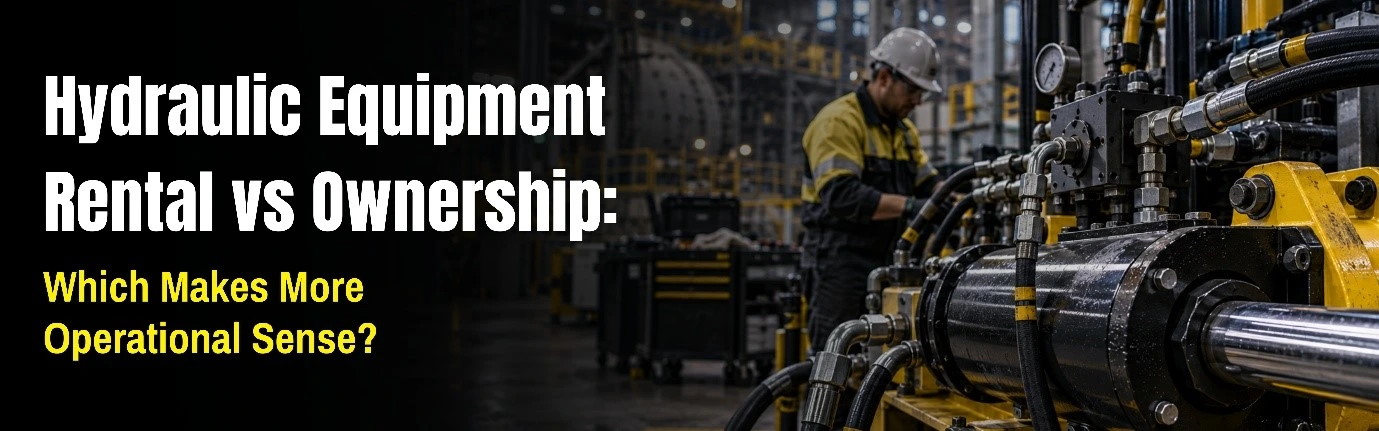
When an industrial operation needs hydraulic equipment, purchasing may seem like the obvious solution.
But the purchase price is only one part of the total operational cost of owning a tool.
Storage, servicing, inspection, repairs, calibration where applicable, equipment management and eventual replacement all become part of the responsibility that follows the purchase.
For mining operations, maintenance departments, shutdown teams and project-based contractors, the more useful question is often not simply:
“Should we buy this equipment?”
It is:
“Does owning this equipment make operational sense for how often we actually need it?”
For South African industrial operations, the answer often comes down to utilisation, lifecycle responsibilities, the nature of the application and the level of flexibility required.
What is the true cost of hydraulic equipment ownership?
The purchase price of a hydraulic tool is easy to identify.
The costs and responsibilities associated with keeping that equipment operational over several years can be less obvious.
Hydraulic equipment ownership may include responsibility for:
- Routine inspection
- Preventative maintenance
- Repairs
- Correct storage
- Equipment tracking
- Replacement of worn components
- Managing periods when equipment is unavailable
- Ensuring equipment remains suitable for future applications
For equipment used regularly, these responsibilities may be justified.
However, equipment that spends long periods in storage can still require maintenance and management even when it is generating limited operational value.
That is where hydraulic equipment rental can become a useful part of an organisation’s equipment strategy.
When does owning hydraulic equipment make sense?
Purchasing equipment can be appropriate where there is predictable and regular demand.
If the same hydraulic tool is used frequently for routine maintenance activities, ownership provides immediate access and allows the organisation to integrate the equipment into its normal operational processes.
Ownership may make operational sense when:
- Utilisation is consistently high
- The application is recurring
- The equipment is critical to everyday operations
- Internal teams can maintain and manage it correctly
- Long-term use justifies the capital investment
The decision should still consider lifecycle responsibilities rather than focusing on purchase price alone.
When can hydraulic equipment rental make more operational sense?
Hydraulic equipment rental provides a different type of value: flexibility.
Instead of committing capital to equipment that may only be required occasionally, businesses can access equipment for a defined period or a specific application.
Several situations can make hydraulic tool rental particularly useful.
Planned shutdowns
Shutdowns can create temporary peaks in equipment demand.
Maintenance teams may require additional hydraulic pumps, cylinders, torque tools or specialised equipment for several days or weeks.
Purchasing equipment solely to meet that temporary requirement may leave assets unused once normal operations resume.
Rental allows an equipment fleet to expand temporarily according to the shutdown requirement.
Short-term projects
Project work does not always justify permanent hydraulic equipment ownership.
If a particular tool is required for a single installation, maintenance project or specialised application, renting can provide access without creating a long-term asset management responsibility.
Emergency backup
Equipment availability becomes particularly important when an owned tool fails during critical work.
Rental equipment can provide backup while existing equipment undergoes inspection or repair, helping maintenance teams maintain operational continuity.
Kiloton positions rental backup as part of its wider lifecycle and uptime support offering, alongside service, repairs, proactive maintenance and technical support.
Specialised applications
Some hydraulic applications require specialised equipment that may only be used occasionally.
Buying equipment that will spend most of its working life in storage may not provide the most appropriate operational value.
Rental can provide access to suitable equipment when the application arises.
Reducing capital lock-up
Capital committed to infrequently used equipment cannot be deployed elsewhere in the operation.
Rental can allow certain requirements to move from long-term capital commitments towards demand-driven equipment access.
The benefit is not only financial. It can also simplify equipment planning.
Rental and ownership can form part of the same uptime strategy
The hydraulic equipment rental versus ownership decision does not have to result in choosing only one approach.
For many industrial operations, a combination of the two can provide greater flexibility.
Frequently used, mission-critical equipment may form part of the organisation’s owned fleet.
Rental can then supplement that fleet during:
- Planned shutdowns
- Short-term projects
- Temporary increases in demand
- Specialised applications
- Periods when owned equipment is undergoing repair or inspection
This approach can form part of a broader uptime strategy that balances equipment ownership with flexible access when requirements change.
Look beyond equipment availability
Whether hydraulic equipment is owned or rented, reliable performance depends on more than simply having the tool available.
Correct equipment selection, safe application, proactive maintenance, servicing and technical support all contribute to lifecycle performance.
Equipment decisions should therefore form part of a broader uptime strategy.
Kiloton supports industrial customers across the equipment lifecycle, including equipment selection, servicing and repair, field support, rental backup and lifecycle management.
Questions to ask before purchasing hydraulic equipment
Before committing to another piece of industrial hydraulic equipment, consider:
- How often will the equipment be used?
- Is the application recurring or temporary?
- Who will maintain the equipment?
- Where will it be stored?
- How will inspections and servicing be managed?
- What happens when it requires repair?
- Could demand increase temporarily during shutdowns or projects?
- Would access to rental equipment provide greater flexibility?
Answering these questions can help maintenance, engineering and procurement teams assess equipment according to operational value rather than purchase price alone.
Planning for temporary hydraulic equipment demand?
Planning a shutdown, project or temporary increase in hydraulic equipment demand?
Speak to Kiloton about hydraulic equipment rental, service and support options for your operation.
Kiloton Rental Backup helps support operational continuity when specialist hydraulic tools are required or when purchasing equipment is not practical.


